Nevada Cottage Food Law (2026): Rules, Limits and How to Start
Do you need a license to sell homemade food in Nevada?
Nevada lets you sell a limited list of shelf-stable homemade foods after you register as a cottage food operation, but the registering authority and the exact fee depend on which county you live in. The current statewide cap is $35,000 in gross sales per year and all sales must be in person, no phone, internet or mail orders. A 2025 law (AB 352) will raise the cap to $100,000 and legalize phone and internet ordering starting July 1, 2027, moving the whole program to a single state license.
Nevada lets you sell homemade food once you register with Local county health authority. There is no commercial-kitchen requirement, so foods like nuts and nut mixes and candies can come straight from your own kitchen after you complete the registration and label step below.
Nevada caps annual cottage food sales at $35,000 gross sales per calendar year. This is the current statewide cap under NRS 446.866 and applies per cottage food operation.
Assembly Bill 352 was passed and takes effect 2027. Nevada passed changes to its cottage food program that take effect in 2027. The current $35,000 per-calendar-year cap and registration rules stay operative until then. This page reflects the rule in force today; the full history sits in the law-updates log.
How much can you sell? The Nevada sales cap
The annual sales limit for a Nevada cottage food operation.
| Item | Nevada rule |
|---|---|
| Annual sales cap | $35,000 gross sales per calendar year |
| How it works | This is the current statewide cap under NRS 446.866 and applies per cottage food operation. AB 352 (2025) raises the cap to $100,000, but that change and the rest of AB 352 do not take effect until July 1, 2027, so $35,000 is the operative figure through the date of this sweep. |
What foods can you sell in Nevada?
Allowed and prohibited categories under current Nevada law.
| Allowed (examples) | Prohibited |
|---|---|
| Nuts and nut mixes; Candies; Jams, jellies and preserves; Vinegar and flavored vinegars; Dry herbs and seasoning mixes; Dried fruits; Cereals, trail mixes and granola; Popcorn and popcorn balls; Baked goods that are not potentially hazardous, contain no cream, uncooked egg, custard, meringue or cream cheese frosting or garnish and do not require time or temperature control for food safety. | Any food requiring time or temperature control for food safety (TCS/potentially hazardous foods); Baked goods containing cream, uncooked egg, custard, meringue or cream cheese frosting or garnish; Meat, poultry and seafood products; Dairy products other than as an ingredient in an allowed baked good; Acidified and low-acid canned foods (these fall under Nevada's separate craft food operation statute, NRS 587.69, not the cottage food category); Fermented foods. |
Nevada cottage food label requirements
Every package you sell needs a label with the elements below in legible print.
- The statutory disclosure statement (verbatim above), printed prominently on the label
- Standard food product labeling elements consistent with federal packaging and labeling law (product name, ingredients, producer identity)
Nevada requires this disclosure statement, word for word:
MADE IN A COTTAGE FOOD OPERATION THAT IS NOT SUBJECT TO GOVERNMENT FOOD SAFETY INSPECTION.
Reproduced from Nevada's cottage food labeling requirements. Confirm the current wording with Local county health authority before you print a run of labels.
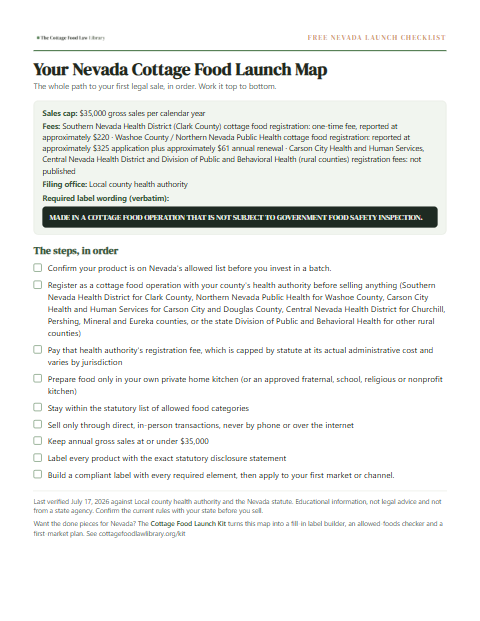
Get the free Nevada cottage food checklist
The one-page map of the steps, in order, so you can see the whole path at a glance.
Instant download, plus Nevada law-change alerts. Unsubscribe anytime.
Where can you sell in Nevada?
The venues and channels Nevada cottage food operators may use.
| Channel | Allowed in Nevada? |
|---|---|
| Direct in-person sale at the operator's private home | Yes |
| Farmers markets, flea markets, swap meets, church bazaars, garage sales and craft fairs | Yes. Must be a licensed or otherwise approved venue and the sale itself must be in person. |
| Retail stores, grocery stores and wholesale accounts | Not clearly authorized. Nevada's cottage food statute is written around direct-to-consumer, in-person sale at approved venues; retail and wholesale placement is not part of that authorization. |
| Phone orders | No. Prohibited under current law. AB 352 legalizes phone orders fulfilled by mail, delivery service or in person starting July 1, 2027. |
| Internet orders | No. Prohibited under current law. AB 352 legalizes internet orders fulfilled by mail, delivery service or in person starting July 1, 2027. |
| Mail or carrier shipping | No. Prohibited under current law. Shipping by mail becomes allowed alongside phone and internet orders once AB 352 takes effect July 1, 2027. |
Registration, training and inspection
Registration and permits. Every cottage food operator must register with the health authority for their county before selling any food item. There is no statewide single registration; the registering authority is whichever county or district health department has jurisdiction where the operator lives, or the state Division of Public and Behavioral Health in rural counties without their own health district. AB 352 (2025) replaces this patchwork with one statewide Nevada Department of Agriculture license effective July 1, 2027.
Food safety training. NRS 446.866 does not require food safety training as a condition of registering a cottage food operation. This sweep found no statewide statutory training mandate, though individual county health authorities were not each individually confirmed and could layer on their own local expectations.
Kitchen inspection. The health authority may inspect a cottage food operation only to investigate a food item that may be adulterated or a known or suspected outbreak of illness caused by a contaminated food item. There is no routine or scheduled inspection of the home kitchen itself.
The fees a Nevada cottage food seller can expect.
| Item | Cost |
|---|---|
| Southern Nevada Health District (Clark County) cottage food registration | one-time fee, reported at approximately $220 |
| Washoe County / Northern Nevada Public Health cottage food registration | reported at approximately $325 application plus approximately $61 annual renewal |
| Carson City Health and Human Services, Central Nevada Health District and Division of Public and Behavioral Health (rural counties) registration fees | Not published; confirm with Local county health authority |