Utah Cottage Food Law (2026): Rules, Limits and How to Start
Do you need a license to sell homemade food in Utah?
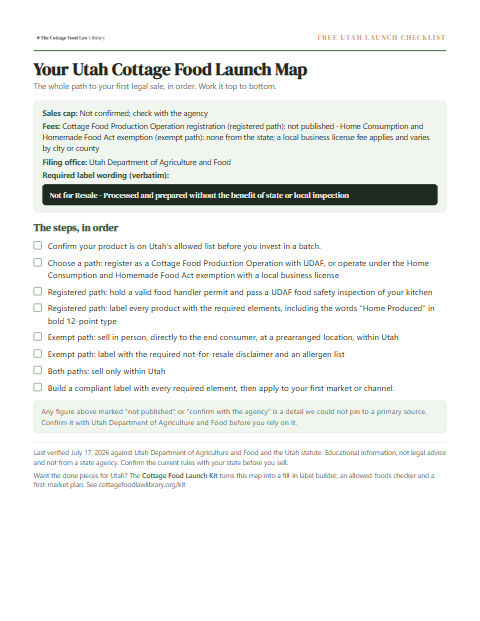
Utah gives you two paths for selling homemade food. The registered Cottage Food Act path lets you sell a wide list of shelf-stable foods in-state at retail or direct to consumers once you register with the Department of Agriculture and Food and pass a kitchen inspection. The exempt Home Consumption and Homemade Food Act path skips state registration but limits you to in-person, direct-to-consumer sales only and carries its own required disclaimer.
In Utah the path depends on what you make and how you sell it. Many home producers of foods like baked goods and cereals, trail mixes and granola need no state license at all, while some foods or channels trigger a registration. The rules below sort out which one is yours.
We could not confirm a specific sales cap for Utah against an official source, so this page does not state a dollar figure. Treat the ceiling as unconfirmed and check the current limit with Utah Department of Agriculture and Food before you scale.
The parts new Utah sellers most often get wrong are the exact label disclosure wording. Each one has its own row below, with the official source beside it.
How much can you sell? The Utah sales cap
The annual sales limit for a Utah cottage food operation.
| Item | Utah rule |
|---|---|
| Annual sales cap | Not confirmed in official sources. Confirm with Utah Department of Agriculture and Food. |
| How it works | No sales cap was found for either the registered Cottage Food Act path or the exempt Home Consumption and Homemade Food Act path in the official sources consulted. Absence of a cap could not be independently confirmed as intentional versus simply undocumented, so this is marked unverifiable rather than 'none'. |
Not published as one current figure everyone cites. Confirm this year's cap with Utah Department of Agriculture and Food before you scale.
What foods can you sell in Utah?
Allowed and prohibited categories under current Utah law.
| Allowed (examples) | Prohibited |
|---|---|
| Baked goods (registered path, with restrictions on fillings and toppings); Cereals, trail mixes and granola; Dried fruits and chocolate-covered dried fruits; Dry herbs and seasoning mixes; Hard candies, freeze-dried candies and cotton candy; Jams, jellies and preserves; Nuts and nut products; Popcorn and popcorn balls; Raw and creamed honey; Repackaging non-TCS foods; Roasted coffee beans; Vanilla extract; Vinegar and flavored vinegar. | Refrigerated or frozen food; Meat or poultry products (limited exemptions for poultry and rabbit exist on the exempt path); Cheesecakes, custards and other high-risk potentially hazardous foods; Raw (unpasteurized) dairy products (exempt path); Other canned, high-risk or potentially hazardous foods. |
Utah cottage food label requirements
Every package you sell needs a label with the elements below in legible print.
- Home Produced in bold 12-point type on the principal display panel (registered path, Rule R70-560-6)
- Product name
- Ingredient list in descending order of predominance by weight
- Major allergen sources
- Net quantity of contents
- Producer name, place of business and telephone number
- Nutrition facts labeling where applicable
- Allergen list (exempt path)
Utah requires this disclosure statement, word for word:
Not for Resale - Processed and prepared without the benefit of state or local inspection
Reproduced from Utah's cottage food labeling requirements. Confirm the current wording with Utah Department of Agriculture and Food before you print a run of labels.
From the team behind this library
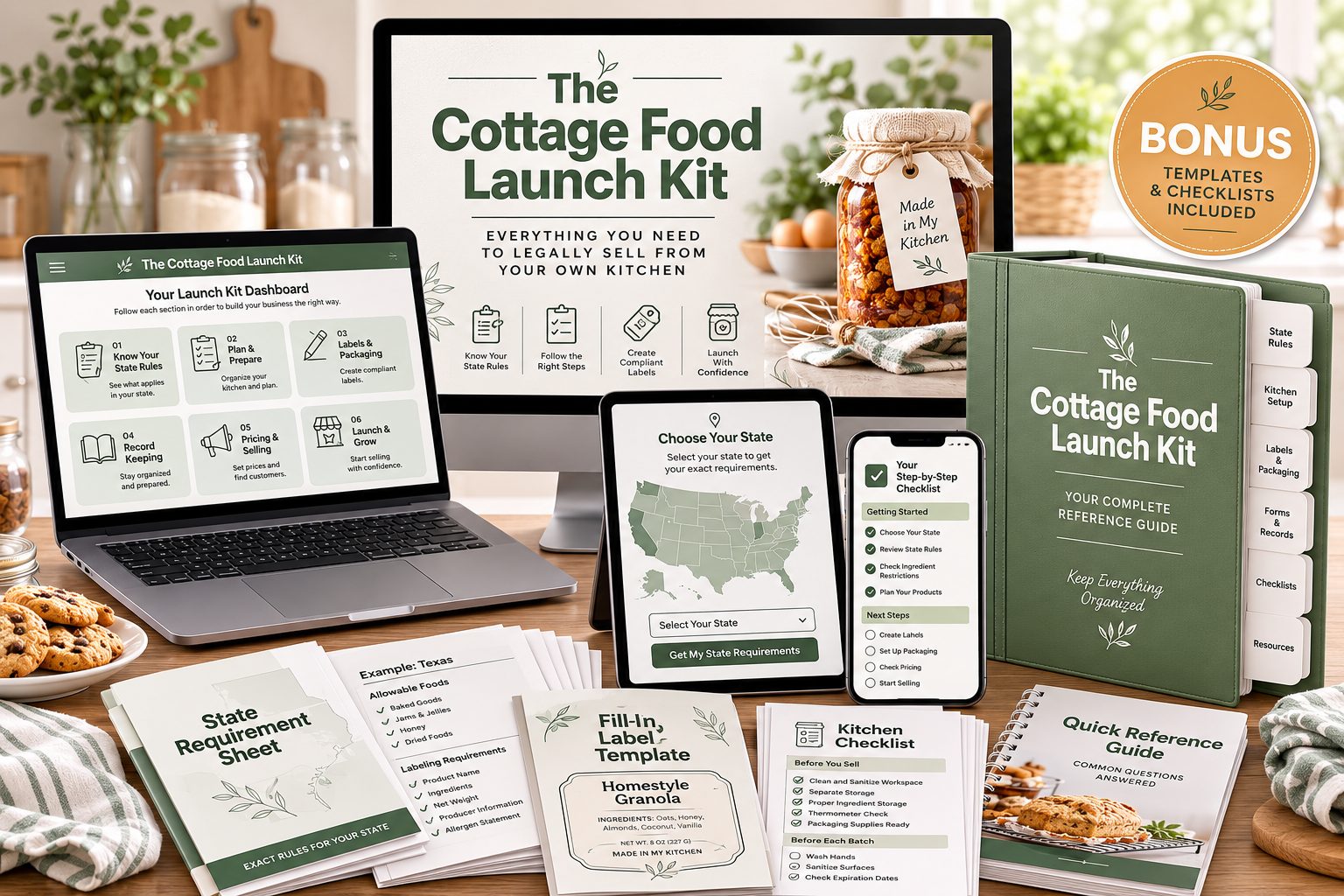
The Cottage Food Launch Kit
Want the whole path in one place? The kit turns everything on this page into one ordered walkthrough for Utah: your state requirement sheet, a fill-in label template with the exact required wording, the allowed-foods checker, the ordered checklist and your first-market plan. Follow it in an evening.
Where can you sell in Utah?
The venues and channels Utah cottage food operators may use.
| Channel | Allowed in Utah? |
|---|---|
| Direct to consumer (registered path) | Yes |
| Stores for resale (registered path) | Yes |
| In-person sale to the end consumer at a prearranged location (exempt path) | Yes. Not for resale; personal or home consumption only. |
| Farmers markets (exempt path) | With conditions. Requires posted signage disclosing the food is homemade and uninspected. |
| Sales outside Utah | No. Both paths restrict sales to within Utah. |
Registration, training and inspection
Registration and permits. Registration with UDAF is required to operate as a registered Cottage Food Production Operation. It is not required under the Home Consumption and Homemade Food Act exempt path, which instead requires a local business license.
Food safety training. The registered Cottage Food Act path requires a valid food handler permit. No training requirement was confirmed for the exempt Home Consumption and Homemade Food Act path.
Kitchen inspection. The registered Cottage Food Act path requires a UDAF food safety inspection of the home kitchen before or after registration. No inspection requirement was confirmed for the exempt Home Consumption and Homemade Food Act path.
The fees a Utah cottage food seller can expect.
| Item | Cost |
|---|---|
| Cottage Food Production Operation registration (registered path) | Not published; confirm with Utah Department of Agriculture and Food |
| Home Consumption and Homemade Food Act exemption (exempt path) | none from the state; a local business license fee applies and varies by city or county |
Not published centrally. Confirm the current amount with Utah Department of Agriculture and Food. Confirm the exact course or certificate Utah Department of Agriculture and Food accepts before you enroll. Confirm the inspection step that applies to your product with Utah Department of Agriculture and Food.
Wondering how Utah compares? See what a cottage food license costs in every state, from the no-fee states to the priciest permits.