New Jersey Cottage Food Law (2026): Rules, Limits and How to Start
Do you need a license to sell homemade food in New Jersey?
New Jersey was the last state in the country to legalize home-based food sales. It only did so effective October 4, 2021, with strict rules: a $100 Cottage Food Operator Permit good for two years, a food protection manager certification and local zoning sign-off before you sell a single item, plus a $50,000 annual sales cap.
New Jersey lets you sell homemade food once you register with New Jersey Department of Health, Cottage Food Program. There is no commercial-kitchen requirement, so foods like baked goods not requiring refrigeration: bread, rolls, biscuits, cakes, cupcakes, pastries, cookies, brownies, muffins, scones, cake pops, macarons, babka, doughnuts, cake rolls and candy: brittle, toffee, bark, caramels, marshmallows, chocolate products can come straight from your own kitchen after you complete the registration and label step below.
New Jersey caps annual cottage food sales at $50,000 gross annual sales. Set in N.J.A.C.
The parts new New Jersey sellers most often get wrong are the exact label disclosure wording, the food safety course and the registration step. Each one has its own row below, with the official source beside it.
How much can you sell? The New Jersey sales cap
The annual sales limit for a New Jersey cottage food operation.
| Item | New Jersey rule |
|---|---|
| Annual sales cap | $50,000 gross annual sales |
| How it works | Set in N.J.A.C. 8:24-11.3(b): gross annual sales from cottage food products may not exceed $50,000. The rule does not describe an inflation adjustment or a per-household vs per-operator distinction; treat it as a flat per-operator ceiling unless the state clarifies otherwise. |
What foods can you sell in New Jersey?
Allowed and prohibited categories under current New Jersey law.
| Allowed (examples) | Prohibited |
|---|---|
| Baked goods not requiring refrigeration: bread, rolls, biscuits, cakes, cupcakes, pastries, cookies, brownies, muffins, scones, cake pops, macarons, babka, doughnuts, cake rolls; Candy: brittle, toffee, bark, caramels, marshmallows, chocolate products; Chocolate-covered nuts and dried fruits; Dried fruit (raisins, apricots, prunes, dates, dried cranberries); Dried herbs and seasonings purchased already dried from a licensed facility; Dried pasta (wheat varieties without egg); Dry baking mixes (pancake, cookie, cake, brownie); Fruit jams and preserves from approved fruits; Fruit pies and empanadas from approved fruit fillings; Fudge, granola, trail mix, nuts and nut butters, popcorn, coffee, tea, vinegars, waffle cones; Other non-time-temperature-control-for-safety foods approved on a case-by-case basis through the state's product questionnaire process. | Any time/temperature-control-for-safety (TCS) food; Cream, sour cream, custard, pudding, vegan custard, cheese, cream cheese; Meat, fish, tofu, soy protein foods; Fresh vegetables, fresh fruit, fresh herbs, fresh flowers, peppers, pumpkin, sweet potato, yams, carrots, mushrooms and heat-treated plant foods like cooked rice, beans or vegetables; Alcohol, CBD and THC products; Home-grown or foraged plants, herbs, vegetables or fruits used as ingredients; Cream cheese frosting, meringue, Swiss meringue, buttercream, French buttercream, German buttercream, whipped cream, ganache; Cheesecake and cotton candy spun on site; Pet food and dog treats; Products made using a freeze-drying or dehydrating machine. |
New Jersey cottage food label requirements
Every package you sell needs a label with the elements below in legible print.
- Product's common name
- Ingredients listed by weight in descending order
- "Contains" followed by the major food allergens present, if any
- Operator's name, business name and Cottage Food Operator Permit number
- The municipality where the operator prepares the product, followed by "New Jersey" or "NJ"
- The statutory disclosure statement (verbatim above)
- At any point of sale that is not the operator's or the consumer's residence, the same disclosure statement must also appear on a posted placard
New Jersey requires this disclosure statement, word for word:
This food is prepared pursuant to N.J.A.C. 8:24-11 in a home kitchen that has not been inspected by the Department of Health.
Reproduced from New Jersey's cottage food labeling requirements. Confirm the current wording with New Jersey Department of Health, Cottage Food Program before you print a run of labels.
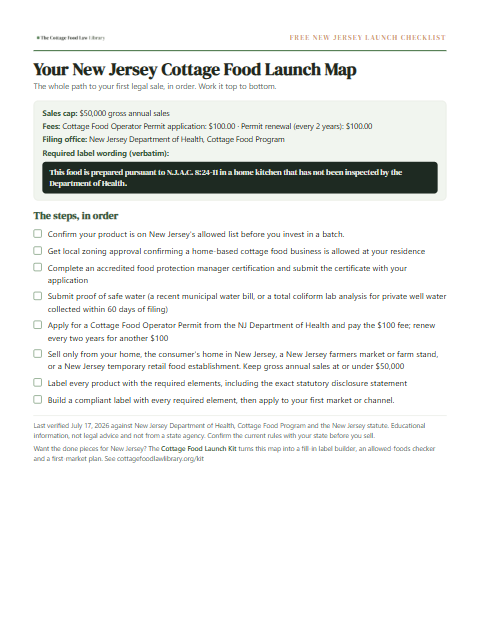
Get the free New Jersey cottage food checklist
The one-page map of the steps, in order, so you can see the whole path at a glance.
Instant download, plus New Jersey law-change alerts. Unsubscribe anytime.
Where can you sell in New Jersey?
The venues and channels New Jersey cottage food operators may use.
| Channel | Allowed in New Jersey? |
|---|---|
| Operator's own home (not for onsite consumption) | Yes |
| Consumer's home | With conditions. Only if the home is in New Jersey |
| New Jersey farmers markets and farm stands | Yes |
| New Jersey temporary retail food establishments (fairs, craft shows, street events) | Yes |
| Online order-taking and payment | With conditions. Accepting orders, payments, marketing and advertising online is allowed, but the resulting delivery must occur inside New Jersey |
| Wholesale to a retail food establishment or another business for resale | No. Prohibited under N.J.A.C. 8:24-11.3 |
| Interstate commerce / shipping outside New Jersey by mail or common carrier | No. Prohibited under N.J.A.C. 8:24-11.3, subject to the narrower in-state delivery allowance in N.J.A.C. 8:24-11.2(b) |
Registration, training and inspection
Registration and permits. A Cottage Food Operator Permit from the NJ Department of Health is required before any sales. Unlike most cottage food states, New Jersey has no unlicensed tier at all.
Food safety training. Applicants must hold a food protection manager certification from an accredited program in good standing, submitted with the permit application. This is a higher bar than the basic food handler course most states require.
Kitchen inspection. The permit process itself does not include a home kitchen inspection. Local health authorities retain the right under N.J.A.C. 8:24-11.5 to enter and examine the home kitchen to confirm compliance or to investigate complaints of contamination, foodborne illness, misbranding or adulteration.
The fees a New Jersey cottage food seller can expect.
| Item | Cost |
|---|---|
| Cottage Food Operator Permit application | $100.00 |
| Permit renewal (every 2 years) | $100.00 |