Tennessee Cottage Food Law (2026): Rules, Limits and How to Start
Do you need a license to sell homemade food in Tennessee?
Tennessee runs one of the most open home food laws in the country under the Tennessee Food Freedom Act. Food made in a home kitchen is exempt from state licensing, permitting, inspection, packaging and labeling requirements, with no sales cap and no required training. A 2025 amendment expanded the allowed list to include certain refrigerated items such as pasteurized dairy and eggs.
Tennessee runs one of the more permissive cottage food laws in the country. You can start selling foods like most homemade foods produced in a home-based kitchen and baked goods, candies, jams, jellies and other traditional shelf-stable cottage foods from your own kitchen with no state permit to file and no dollar ceiling on your sales. Once you meet the labeling step below you are clear to sell.
Tennessee sets no dollar limit on cottage food sales, so the ceiling on your growth is your own kitchen and time rather than a statutory cap. The other rules that matter, the label, the allowed foods and where you can sell, are in the tables below.
a 2025 amendment was enacted in 2025. Tennessee widened the foods a home producer may sell to include some time and temperature-controlled items, while keeping meat, fish, shellfish and alcohol off-limits. Confirm the current scope and effective date with the Tennessee Department of Agriculture. This page reflects the rule in force today; the full history sits in the law-updates log.
How much can you sell? The Tennessee sales cap
The annual sales limit for a Tennessee cottage food operation.
| Item | Tennessee rule |
|---|---|
| Annual sales cap | No annual dollar cap in Tennessee |
| How it works | The Tennessee Food Freedom Act sets no sales limit for homemade food producers. |
What foods can you sell in Tennessee?
Allowed and prohibited categories under current Tennessee law.
| Allowed (examples) | Prohibited |
|---|---|
| Most homemade foods produced in a home-based kitchen; Baked goods, candies, jams, jellies and other traditional shelf-stable cottage foods; Pasteurized dairy products including butter, yogurt, hard cheese and kefir (added by the 2025 amendment, effective July 1, 2025); Eggs (added by the 2025 amendment, effective July 1, 2025). | Raw (unpasteurized) milk and raw milk products; Meat, meat byproducts and meat food products (excluded from the 2025 time/temperature-controlled expansion); Fish and shellfish products (excluded from the 2025 time/temperature-controlled expansion); Alcoholic beverages; Foods requiring interstate shipment out of Tennessee. |
Tennessee cottage food label requirements
Every package you sell needs a label with the elements below in legible print.
- No state-mandated label disclosure was confirmed. The act exempts homemade food producers from the state's packaging and labeling laws.
No single statewide disclosure sentence. Tennessee does not set one required disclosure line in the sources we checked. Put the required elements above on every label. Confirm the current wording with Tennessee Department of Agriculture before you print a run.
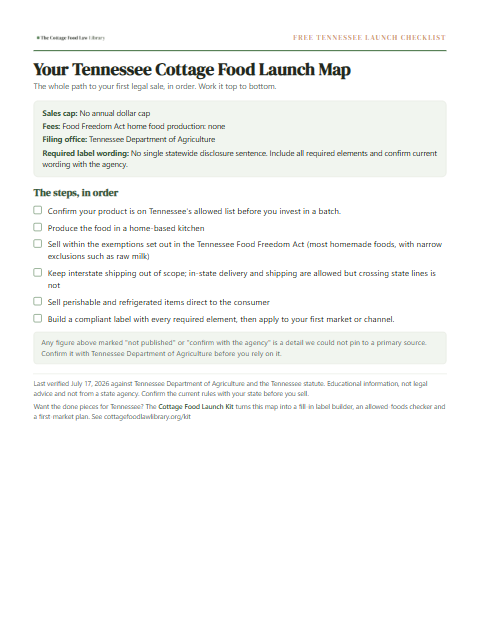
Get the free Tennessee cottage food checklist
The one-page map of the steps, in order, so you can see the whole path at a glance.
Instant download, plus Tennessee law-change alerts. Unsubscribe anytime.
Where can you sell in Tennessee?
The venues and channels Tennessee cottage food operators may use.
| Channel | Allowed in Tennessee? |
|---|---|
| Direct to consumer from home | Yes |
| Farmers markets and public events | Yes |
| Retail stores | Yes |
| Online orders with in-state delivery or shipping | Yes |
| Shipping across state lines | No. Interstate shipping is not permitted under the act. |
Registration, training and inspection
Registration and permits. No registration, permit or license is required to produce and sell homemade food under the Tennessee Food Freedom Act.
Food safety training. No food safety training is required under the act.
Kitchen inspection. No home-kitchen inspection is required. The Department of Health retains authority only to investigate a reported foodborne illness.
The fees a Tennessee cottage food seller can expect.
| Item | Cost |
|---|---|
| Food Freedom Act home food production | No state fee |