West Virginia Cottage Food Law (2026): Rules, Limits and How to Start
Do you need a license to sell homemade food in West Virginia?
West Virginia has long allowed non-potentially-hazardous homemade foods to be sold without a permit, training or inspection. Senate Bill 44, effective June 12, 2026, adds a new path: a potentially-hazardous cottage food vendor permit that lets producers sell acidified, pickled, fermented and time/temperature-controlled foods, with a kitchen inspection, training and water testing required for that permit. Meat, poultry, seafood and Grade A dairy stay off-limits under both paths.
In West Virginia the path depends on what you make and how you sell it. Many home producers of foods like acidified, pickled or fermented foods need no state license at all, while some foods or channels trigger a registration. The rules below sort out which one is yours.
We could not confirm a specific sales cap for West Virginia against an official source, so this page does not state a dollar figure. Treat the ceiling as unconfirmed and check the current limit with West Virginia Department of Agriculture before you scale.
Senate Bill 44 took effect June 12, 2026. West Virginia created a new potentially-hazardous cottage food vendor permit for acidified, pickled, fermented and temperature-controlled foods, with a kitchen inspection, training and water testing. The Department of Agriculture was still drafting the fee schedule and detailed rules at the effective date. This page reflects the rule in force today; the full history sits in the law-updates log.
How much can you sell? The West Virginia sales cap
The annual sales limit for a West Virginia cottage food operation.
| Item | West Virginia rule |
|---|---|
| Annual sales cap | Not confirmed in official sources. Confirm with West Virginia Department of Agriculture. |
| How it works | No sales cap was confirmed for either the non-potentially-hazardous or the new potentially-hazardous cottage food path in the sources consulted. |
Not published as one current figure everyone cites. Confirm this year's cap with West Virginia Department of Agriculture before you scale.
What foods can you sell in West Virginia?
Allowed and prohibited categories under current West Virginia law.
| Allowed (examples) | Prohibited |
|---|---|
| Non-potentially-hazardous homemade food items not requiring time or temperature control for safety; Acidified, pickled or fermented foods (new potentially-hazardous permit, effective June 12, 2026); Time and temperature-controlled foods (new potentially-hazardous permit, effective June 12, 2026). | Meat products; Poultry products; Seafood; Grade A dairy products. |
These lists follow West Virginia Department of Agriculture's published guidance. Confirm your own product against West Virginia Department of Agriculture before you commit to a batch.
West Virginia cottage food label requirements
Every package you sell needs a label with the elements below in legible print.
- Not confirmed. The West Virginia Department of Agriculture was still developing labeling requirements for the new potentially-hazardous permit as of the law's effective date.
No single statewide disclosure sentence. West Virginia does not set one required disclosure line in the sources we checked. Put the required elements above on every label. Confirm the current wording with West Virginia Department of Agriculture before you print a run.
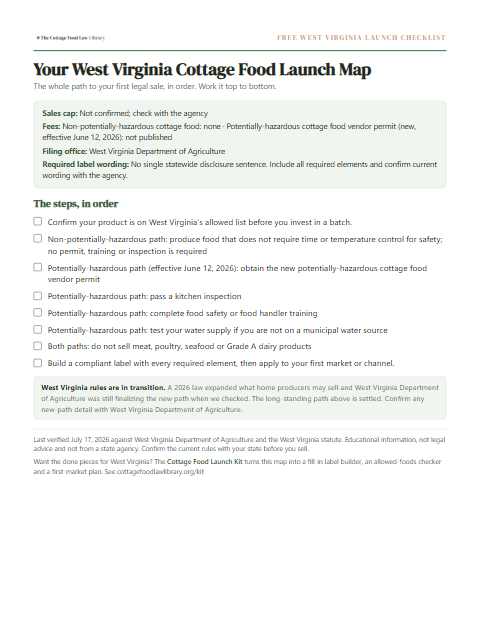
Get the free West Virginia cottage food checklist
The one-page map of the steps, in order, so you can see the whole path at a glance.
Instant download, plus West Virginia law-change alerts. Unsubscribe anytime.
Where can you sell in West Virginia?
The venues and channels West Virginia cottage food operators may use.
| Channel | Allowed in West Virginia? |
|---|---|
| Direct to consumer from home | Yes. Non-potentially-hazardous foods. |
| Farmers markets | Yes. The legislature separately acted to remove the farmers market vendor permit fee. |
| Other venues under the new potentially-hazardous permit | Not confirmed. Not confirmed at verification. |
Registration, training and inspection
Registration and permits. Not required for non-potentially-hazardous foods. Required for potentially-hazardous foods (acidified, pickled, fermented, time/temperature-controlled) as of June 12, 2026, via the new potentially-hazardous cottage food vendor permit.
Food safety training. Not required for non-potentially-hazardous foods. Required for the new potentially-hazardous cottage food vendor permit: food safety or food handler training. The specific accredited course was not confirmed at verification.
Kitchen inspection. Not required for non-potentially-hazardous foods. Required for the new potentially-hazardous cottage food vendor permit, along with water testing for non-municipal water sources.
The fees a West Virginia cottage food seller can expect.
| Item | Cost |
|---|---|
| Non-potentially-hazardous cottage food | No state fee |
| Potentially-hazardous cottage food vendor permit (new, effective June 12, 2026) | Not published; confirm with West Virginia Department of Agriculture |
Not published centrally. Confirm the current amount with West Virginia Department of Agriculture. Confirm the exact course or certificate West Virginia Department of Agriculture accepts before you enroll.