Montana Cottage Food Law (2026): Rules, Limits and How to Start
Do you need a license to sell homemade food in Montana?
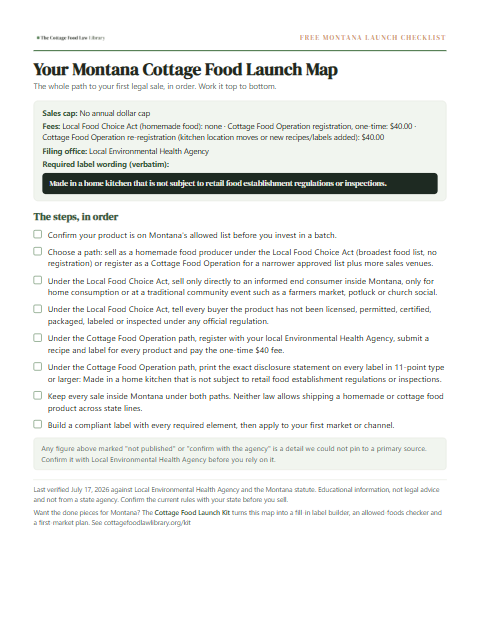
Montana runs two separate paths for home food sales. Under the Local Food Choice Act you can sell almost any homemade food, including many potentially hazardous foods, directly to an informed local consumer with no permit, no cap and no packaged label, as long as you stay in Montana and tell the buyer the product is unlicensed and uninspected. The older Cottage Food Operation path covers a narrower list of shelf-stable foods with wider market access after a one-time $40 registration and a printed disclosure label.
In Montana the path depends on what you make and how you sell it. Many home producers of foods like under the local food choice act: most homemade foods sold directly to an informed consumer, including many potentially hazardous items, subject to separate meat, poultry and dairy rules and under the cottage food operation path: baked goods such as breads, rolls, cakes, cookies, crackers, granola and most pies need no state license at all, while some foods or channels trigger a registration. The rules below sort out which one is yours.
Montana sets no dollar limit on cottage food sales, so the ceiling on your growth is your own kitchen and time rather than a statutory cap. The other rules that matter, the label, the allowed foods and where you can sell, are in the tables below.
The parts new Montana sellers most often get wrong are the exact label disclosure wording. Each one has its own row below, with the official source beside it.

How much can you sell? The Montana sales cap
The annual sales limit for a Montana cottage food operation.
| Item | Montana rule |
|---|---|
| Annual sales cap | No annual dollar cap in Montana |
| How it works | No cap has ever existed on the Cottage Food Operation path. MCA 50-50-116 and 50-50-117 both carry the history line "En. Sec. 1 [and 2], Ch. 239, L. 2015" with no amendment since and neither section contains any dollar figure; MCA 50-49-203 contains none either. Re-verified 2026-08-15. |
What foods can you sell in Montana?
Allowed and prohibited categories under current Montana law.
| Allowed (examples) | Prohibited |
|---|---|
| Under the Local Food Choice Act: most homemade foods sold directly to an informed consumer, including many potentially hazardous items, subject to separate meat, poultry and dairy rules; Under the Cottage Food Operation path: baked goods such as breads, rolls, cakes, cookies, crackers, granola and most pies (not custard, fresh-fruit-topped or refrigerated pies); Dried fruit; Standardized jams, jellies, preserves and fruit butters made with an approved fruit list; Dry herb, spice, tea, coffee and soup mixes; Popcorn, popcorn balls and cotton candy; Fudge, candies and confections that need a cook step and no refrigeration; Molded chocolate made with commercial chocolate melts; Honey. | LOCAL FOOD CHOICE ACT PATH: meat and meat products may not be used in preparing homemade food sold under the Act, however they were processed (at a state-licensed establishment, at a federally approved establishment, by the producer or by any third party). The only carve-outs are a temporary food establishment subject to MCA 50-50-120 and a producer who slaughters fewer than 1,000 poultry birds a year under 9 CFR 381.10(c) and 381.175; Wild game, game fish, game birds, game animals and fur-bearing animals (MCA 87-6-206); Any chicken ingredient such as chicken stock or chicken bouillon that does not qualify under the 1,000-bird exemption; Alcohol and alcohol-infused products (still governed by Montana liquor control law); THC and marijuana-infused products (still governed by Montana marijuana law); Dairy products and eggs (not eligible under the Cottage Food Operation path); Fermented foods such as lacto-fermented pickles; Freezer jams or jellies and any product that needs refrigeration; Custard or cream pies, pumpkin pie and cheesecake; Pet treats; Sale to a retail store, restaurant or wholesaler under either path; Any sale to a buyer located outside Montana. |
Montana cottage food label requirements
Every package you sell needs a label with the elements below in legible print.
- Name, address, city, state and zip code of the cottage food operation
- Name of the cottage food product
- Ingredients listed from highest weight to lowest weight, with sub-ingredients in parentheses
- Net quantity, weight, count or volume
- Allergen labeling for common allergens (milk, wheat, eggs, peanuts, tree nuts and soy)
- The disclosure statement above, printed in at least the equivalent of 11-point font size in a color that provides a clear contrast to the background, conspicuously placed on the principal label (Cottage Food Operation path, MCA 50-50-116(2)(b)(vii))
- Under the Local Food Choice Act, no printed label is required. The producer must instead directly inform the buyer the product is not licensed, permitted, certified, packaged, labeled or inspected
Montana requires this disclosure statement, word for word:
Made in a home kitchen that is not subject to retail food establishment regulations or inspections.
Reproduced from Montana's cottage food labeling requirements. Confirm the current wording with Local Environmental Health Agency before you print a run of labels.
From the team behind this library
The Cottage Food Launch Kit
Want the whole path in one place? The kit turns everything on this page into one ordered walkthrough for Montana: your state requirement sheet, a fill-in label template with the exact required wording, the allowed-foods checker, the ordered checklist and your first-market plan. Follow it in an evening.
Where can you sell in Montana?
The venues and channels Montana cottage food operators may use.
| Channel | Allowed in Montana? |
|---|---|
| Direct to consumer at the producer's home | Yes. Both paths |
| Farmers markets, bazaars, fairs and traditional community events | Yes. Qualifies under the Local Food Choice Act's traditional community event definition; also a standard Cottage Food Operation venue |
| Roadside stand or parking lot table | With conditions. Allowed under the Cottage Food Operation path subject to local permit ordinances and property owner permission. The Local Food Choice Act limits sales outside the home to a traditional community event, so an ordinary roadside table does not clearly qualify |
| Online orders with face-to-face delivery or pickup | With conditions. Advertising online is fine but the sale must be a face-to-face, in-person transaction. Courier, mail and marketplace shipping (USPS, UPS, FedEx, Amazon, eBay) are not allowed |
| Retail stores, restaurants and wholesale accounts | No. Prohibited under both paths (the Local Food Choice Act carries a narrow exception for raw, unprocessed fruit, vegetable and aquaculture products sold at retail) |
| Mail order, shipping or any sale across state lines | No. Both paths keep transactions inside Montana only |
Registration, training and inspection
Registration and permits. No registration under the Local Food Choice Act. Registration with the local Environmental Health Agency, plus a one-time $40 fee, is required only if operating under the older Cottage Food Operation path instead.
Food safety training. Neither the Local Food Choice Act nor the Cottage Food Operation path requires a food handler course, certification or training in any primary source reviewed.
Kitchen inspection. No inspection authority at all under the Local Food Choice Act beyond general disease-outbreak investigation. A Cottage Food Operation registrant is not routinely inspected but signs the registration agreeing to allow a home inspection if a complaint or illness is linked to a product.
The fees a Montana cottage food seller can expect.
| Item | Cost |
|---|---|
| Local Food Choice Act (homemade food) | No state fee |
| Cottage Food Operation registration, one-time | $40.00 |
| Cottage Food Operation re-registration (kitchen location moves or new recipes/labels added) | $40.00 |
Not published centrally. Confirm the current amount with Local Environmental Health Agency.
Wondering how Montana compares? See what a cottage food license costs in every state, from the no-fee states to the priciest permits.
Two Montana laws, two names, two different deals
Montana is one of the few states where a home food seller genuinely chooses between two laws. They have different names, different paperwork and different limits on where you may sell, so working out which one you are using is the first decision, not a detail.
The Local Food Choice Act
Senate Bill 199 (2021) created it and it lives at MCA 50-49-201 through 50-49-203. The statute defines homemade food as food prepared in a private home that is not licensed, permitted, certified, packaged, labeled or inspected under any official regulations, which is a rare thing to see written down: the law names the absence of all of it as the point. In exchange, your buyer has to be an informed end consumer, defined as the last person to purchase the product, who does not resell it and who has been told the product carries none of those approvals. Delivery may happen at a farm, a ranch, a home, an office, a traditional community social event, other private property or another location the two of you agree on.
The Cottage Food Operation registration
This is the older and narrower path, run through DPHHS with your county Environmental Health Agency. It covers a shorter list of shelf-stable foods and it asks for a one-time $40 registration plus a printed disclosure label. What you get back is reach: a registered cottage food operation may sell through venues the Local Food Choice Act does not open. DPHHS points to MCA 50-50-101 through 50-50-403 for retail food, temporary event permitting and cottage foods, with the cottage food rules themselves at ARM 37.110.501 to 37.110.504.