Penalties for Selling Food Without a License, State by State
Enforcement usually starts with a complaint. The figures live in each state's licensing law. Getting registered is usually the whole fix.
The honest answer is that it depends on your state. In most states the first thing that happens is a letter rather than a fine. Selling homemade food without the registration or permit your state asks for is a licensing problem, so the consequence is written into your state's food licensing law rather than into its cottage food law. A few states put a dollar figure in the statute. Most leave it to the agency holding the file. Nearly all of them start from somebody complaining rather than from anyone patrolling. What follows is what is actually written down, what nobody can promise you and what the fix costs, which in most states is nothing.
Enforcement starts with a complaint, not a patrol
Three of the biggest cottage food states say this in their own words. California keeps its inspectors out of a Class A operation: Health and Safety Code section 114365 says such an operation "shall not be subject to initial or routine inspections" and lets an officer into the home only where a consumer complaint gives reason to suspect unsafe food. New York tells home processors that "kitchens are reviewed on a complaint basis only". Texas goes further still, telling the public that health departments hold no regulatory authority to inspect a cottage food production operation, while section 437.0192(b) requires each local health department to keep a record of any complaint made against one. Recording a complaint is a filing duty rather than an inspection trigger.
That is a pattern rather than a national rule. One state runs the other way. Washington inspects the permitted area of every cottage food operation before the permit issues, then annually afterwards, under RCW 69.22.040(1). Anyone telling you what "usually" happens across all 51 jurisdictions is guessing.
The exemption is a boundary, not a shield
Your state's cottage food law describes a space: certain foods, up to a certain amount, sold through certain channels. Inside that space most states have no permit to revoke and no fee to collect, which is why the penalty question so often has no answer at all. You leave that space in one of three ways: by making a food your state excludes, by passing your annual cap or by selling through a channel your state does not allow. Once you are outside it, the ordinary food licensing law applies to you. That is the law the fines and the offense classes were written into.
The figures that are written into law
These are the states where the number sits in a statute or on an agency page rather than in somebody's forum post. Everything here applies to the licensed side of the line described above.
| State | What is written down | Where |
|---|---|---|
| Washington | Engaging in a cottage food operation without a valid permit is a misdemeanor, a gross misdemeanor for a second or later violation within five years, plus a civil penalty not exceeding $1,000 per violation per day | RCW 69.22.090 |
| California | Operating a food facility without the necessary permits carries closure of the facility plus a penalty not to exceed three times the cost of the permit | Health and Safety Code 114387 |
| Texas | No penalty for a cottage food operation, which the state does not license. On the licensed side, operating without a department permit is a Class A misdemeanor with each day a separate offense. Manufacturing food without the state license carries a civil penalty of up to $25,000 a day | HSC 437.0165 and 431.0585(b) |
| Florida | Operating a public food service establishment without a license is a second degree misdemeanor, with the division able to impose fines not to exceed $1,000 per offense | FS 509.241(1) and 509.261(1)(a) |
| New York | A food processing establishment may not operate unlicensed, each day counts as a separate violation and the civil penalty runs to not more than $600 for a first violation and $1,200 for a later one | AGM 251-z-10 and section 39 |
Two things to take from that table. The figures differ by an order of magnitude between neighbors, so a number you read about one state tells you nothing about your own. And in every row the penalty attaches to operating a licensed kind of business without its license, which is why staying inside your state's cottage food exemption is the whole game.
What a first contact usually looks like
Minnesota is the clearest state to read here, because its statute lists the tools rather than hiding them. Under Minn. Stat. 34A.06 the commissioner may use a "written warning, administrative meeting, cease and desist, forced sale, detention, embargo, condemnation, citation, corrective action order, seizure, agreement, withdrawal from distribution, or administrative penalty". A written warning and a cease and desist order sit at the front of that list. Nothing in the section makes them a required first step.
Texas says the same thing in plainer language. Its enforcement page declines to promise a sequence: the action taken depends on the severity of the offense, the history of previous violations, the efforts made to correct the violation and other matters particular to the case. The honest shape of it is this. A complaint usually produces a letter asking you to stop or to put something right. That letter is usually the moment to fix the underlying paperwork. No state owes you a warning first.
The whole path in one place, before you need any of this
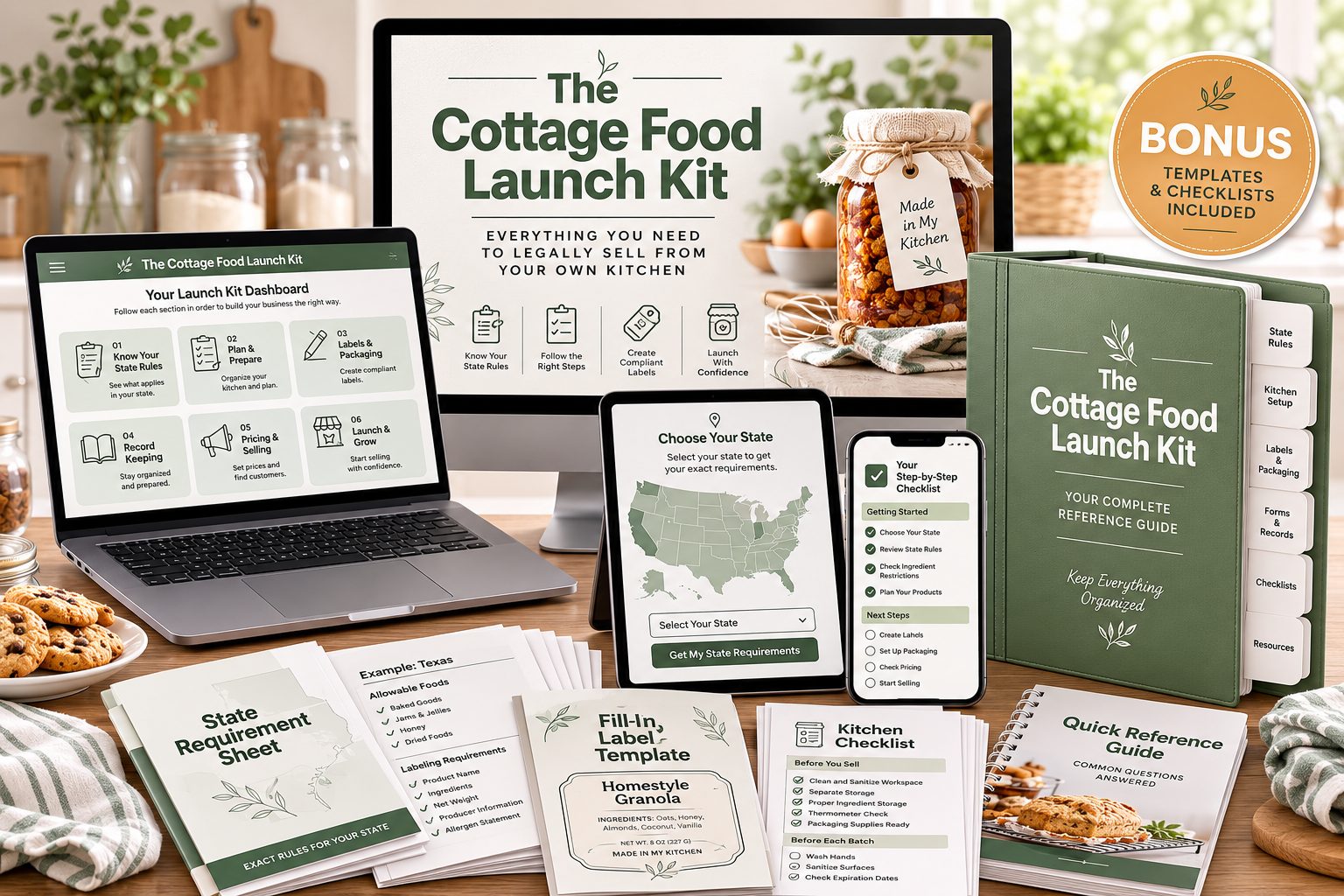
From the team behind this library
The Cottage Food Launch Kit
Want the whole path in one place? The Cottage Food Launch Kit turns the rules for your state into one ordered walkthrough: your requirement sheet, a fill-in label template with the exact required wording, the allowed-foods checker, the ordered checklist and your first-market plan.
The fix is usually a form, usually a free one
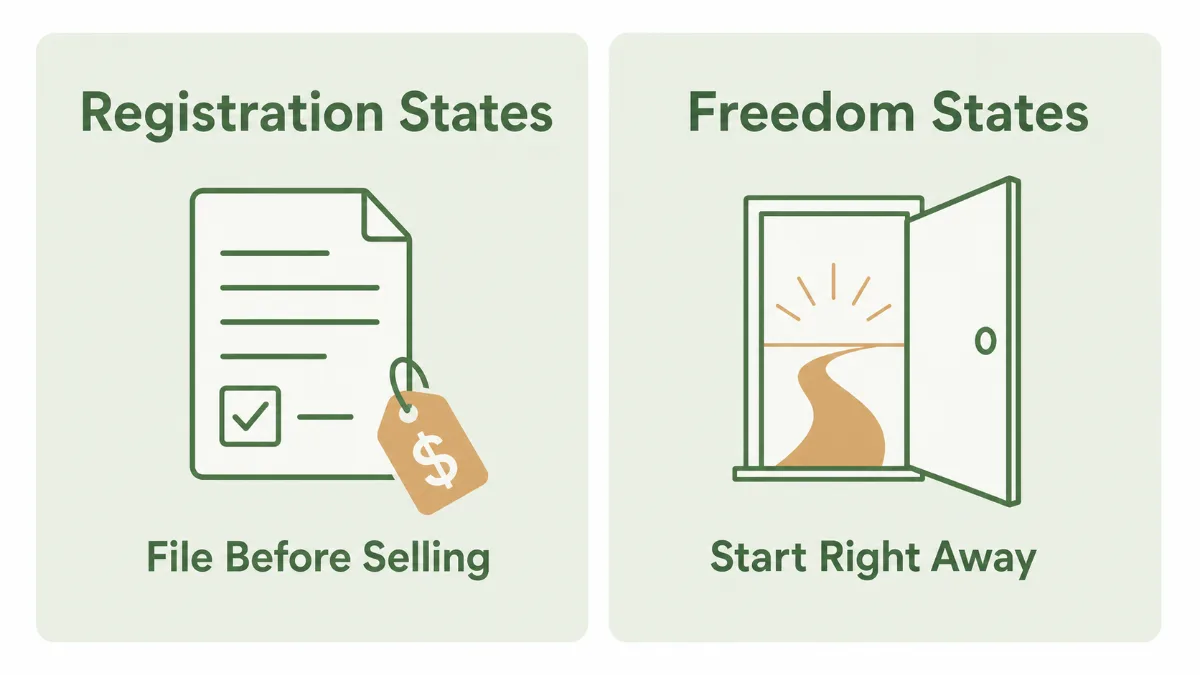
The penalty talk buries the cheap part. In 17 US jurisdictions there is no state registration to file at all, so there is nothing to be caught without. Where a state does ask for something, it is most often a free or low-cost registration rather than a license. The cost-by-state guide puts every fee in one table so you can see how small the number usually is. The licensing guide sorts all 51 jurisdictions into the ones that require nothing, the ones that want a registration or permit and the ones where it depends on your food.
If you have already sold something
Nobody who starts a home food business sets out to break a rule. Most people who end up here found the rule after the first market day, which is a normal way round. Four practical steps, in the order they help:
- Read your state page and find the one requirement you missed. It is usually a registration, a course or a label line rather than a license.
- Stop selling anything your state excludes. Refrigerated items, canned low-acid goods and anything with meat or dairy in it are the usual ones. A food outside your state's list is the thing that moves you outside the exemption entirely.
- File the paperwork, then keep the receipt. Where a registration exists it is often processed in days. Your state page names the office and links its form.
- Answer any letter you receive. Agencies describe corrective action and agreements among their tools. Ignoring a notice is the one move that reliably makes it worse.
You can also check a specific product in a minute with the free can-I-sell-this checker, which reads each state's own allowed and prohibited lists.
Find your state
Every state page carries the requirement, the sales cap, the label wording and the office that handles it, each cited to the statute or agency and dated. The licensing guide's summary of this question sits alongside it.
This guide is educational information, not legal advice. Penalties and enforcement practice are set by each state and sometimes by a county. Both change. If you have received a formal notice or an order, talk to a lawyer licensed in your state rather than relying on a web page.
Selling without a license FAQ
What is the penalty for selling food without a license in Texas?
For a cottage food production operation there is no penalty, because Texas does not license one. Health and Safety Code section 437.0192 bars a local government authority from requiring any type of license or permit or charging a fee. The penalties start on the licensed side of that line: operating a food service establishment or retail food store without a department permit is a Class A misdemeanor under section 437.0165, with each day a separate offense. Manufacturing food without the state license carries a civil penalty of up to $25,000 a day under section 431.0585(b).
Can you go to jail for selling food without a license?
In several states the offense is written as a misdemeanor, which is a criminal classification: Washington under RCW 69.22.090, Florida under statute 509.241(1) and Texas on its licensed side under section 437.0165. Whether anybody is ever prosecuted is a separate question that depends on the case. Agencies describe a range of actions from a written warning upward. No page can tell you what will happen in your own case.
What usually happens first if someone reports you?
Most states start from a complaint rather than a patrol. The first contact is usually a letter. Minnesota lists thirteen actions its commissioner may take, beginning with a written warning and a cease and desist order. Texas states plainly that the action depends on the severity, the history of previous violations and the effort made to correct it, so no state promises a warning comes first.
What happens if I go over my state's sales cap?
You leave the exemption. The cottage food law stops covering you at that point and the ordinary food licensing rules apply, which is where permits and penalties live. If you are close to your cap, your state page carries the current figure and the licensed path that follows it.
How do I fix it if I have already been selling without registering?
Open your state page and read the requirement, then file it. In 17 US jurisdictions there is nothing to file at all. Where a registration exists it is often free or under $100. Stop selling any product your state excludes while you sort it out. Answer any letter you receive rather than leaving it.